
This interview originally appeared on Comics Beat by Steve Morris.
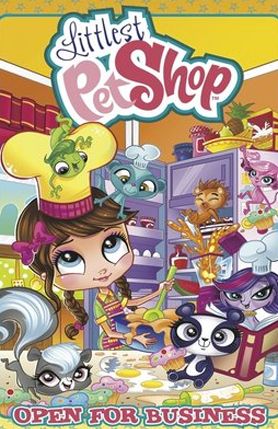
This May, IDW will continue to develop their range of all-ages titles with The Littlest Pet Shop, from the twin creative teams of Georgia Ball and Nico Pena; and Matt Anderson and Antonio Campo. Based on the Hasbro range-turned cartoon series, the series is about Blythe Baxter, a young girl who can talk and understand the various animals who live in the pet shop where she lives.
I’ve always got an interest in finding out more about all-ages comics, wherever they may appear, and Ball has written a number of really strong comics within that range. Reaching out to her, she spoke candidly about her approach to the series, writing for a younger audience – and her thoughts on the abundance of female writers currently working on all-ages comics. This looks like it’ll be a really entertaining book, and I’m grateful that she took the time out to answer some of my questions.
Steve: What exactly is the Littlest Pet Shop? What’s the core concept of the series, as you’re approaching it?
Georgia: Through mysterious means that may involve a dumbwaiter, heroine Blythe Baxter can understand the animals in the pet shop below her home. From there, Littlest Pet Shop alternates between stories about a young girl with a single dad trying to survive middle school and her group of quirky friends who spend every day together and need to find ways to entertain themselves without driving each other crazy.
The twist is those friends are also pets in a day camp.
Steve: The series centres around Blythe Baxter, who has the power to talk to animals. What’s she like as a character? What’s her personality like, what’re her motivations, and so on?
Georgia: Blythe is grounded, upbeat, helpful and a self-starter. She’s also prone to anxiety and self-doubt. A lot is made out of her interest in fashion, but at the core of that interest is her unstoppable creative energy. She needs to design and she will find a way to do it, something many girls who drew fanart in their notebooks while growing up can get behind. Although her huge wardrobe and love for all things sparkly identifies her as a “girly-girl,” Hasbro hasn’t objected to my giving her some additional geeky interests, like trading card games and the X-Men.
Steve: Who’ve been your favourite of the animals to write about? Are there any you’ve been surprised to find yourself really latching onto?
Georgia: Vinnie is an easy character to turn into a punchline. He’s not a deep thinker and that offers a lot of opportunities for one-off jokes. Zoe’s issue was fun to write because she can be so self-absorbed. I love writing for the Biskit twins too, I’ve had plenty of catty things said to me over the years and the twins give me an outlet to take that to another level.
Steve: Did you do much research into the series once you came on? Were you already aware of the TV show and the other media adaptations before you started writing?
Georgia: When I’m given the chance to pitch for a new property I spend weeks learning everything I can about it. If there’s a show I watch every episode, if there’s a video game I buy it and play. I knew Littlest Pet Shop was a cartoon show so I bought the first season on Amazon and spent my lunches catching up. I went to the Internet and got a sense of the size of the fandom and what they talk about. I avoided the previous television incarnation because it wasn’t relevant. It would be great to say I was already familiar with the concept and a huge fan of the series, but working in licensing often introduces me to properties I’m unfamiliar with because the creative process has to start so early, the property may not be very far along yet. When I was given the chance to pitch for The Croods I had to come up with stories about characters eight months before their movie was out.
Steve What’re your goals for the series? What do you hope people get out of it?
Georgia: Licensed properties like Strawberry Shortcake and My Little Pony end with a neatly-declared moral lesson and I did that for three years. Hasbro has given me the opportunity on this series to be much more ambiguous. The Seinfeld philosophy was “No hugging, no learning” because it’s funnier without sentiment. Above all else, I want this series to provide comedy and entertainment.
Steve: Have you found that as you’ve written more and more, you’ve started to refine the comics for a more general audience? Do you tailor the comics so younger readers find them easier to read?
Georgia: I was brand-new to licensed comics when I wrote for Strawberry Shortcake; I dumbed-down the language in the first two issues and I’ve regretted it ever since. I don’t want to talk down to the reader, I want to give younger readers the chance to age and grow with their comics, getting more and more out of them the longer they own them. That’s how it was for me reading Archie and my mother’s old copies of Sugar and Spike, and I think it’s the kind of approach that creates long-term fans.
Steve: Looking back through your career thus far, I believe you’ve written entirely all-ages comics, from Scooby Doo to My Little Pony. Did you jump into comics with that specific goal in mind – that you’d try and focus on writing comics that everybody can read?
Tags: comics