
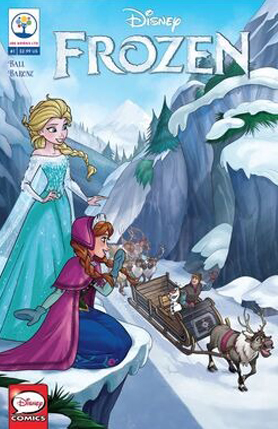
The short review (published on worldcomicbookreview.com) looks at Frozen #1, a licensed Disney comic from Joe’s Books written by Georgia Ball. It’s positioned as a light, post-movie tie-in for young readers (roughly pre-teens) and features two short stories set in the kingdom of Arendelle after the events of the 2014 Frozen animated film.
Comic review highlights:
- Story 1: A comical dispute breaks out between reindeer herdsmen (who want to drive their migrating herds through a meadow because their usual mountain pass is blocked by snow) and local oxen herdsmen (who are upset because the reindeer are trampling the grass their oxen eat). Queen Elsa and Princess Anna get involved. Elsa ultimately uses her ice powers to create a frozen bridge over the meadow, allowing the reindeer to pass while the two groups reach a compromise (including some dairy-product payments and ox-hair rugs).
- Story 2: The main characters discover a secret tunnel running from the castle straight to a local grocery shop. They speculate about its history, but the “adventure” ends without any real payoff or excitement.
The reviewer calls both tales “nothing remarkable.” The writing is described as safe, formulaic, and aimed squarely at a young audience that wants to see ice powers and familiar characters (Elsa, Anna, the reindeer Sven, Kristoff, and Olaf). The first story lightly pushes themes of communication and compromise, while the second is labeled “entirely mundane even for pre-teens” and ultimately pointless. No comments are made on the artwork.Bigger picture / Disney & parody angle:The review spends more time discussing how Disney has softened its historically aggressive stance against unauthorized parodies. It contrasts the tame licensed Frozen comic with edgy online parodies of the movie (such as Frozen characters mashed up with Mass Effect, Grand Theft Auto, or a twisted Michael Jackson “Thriller” video). The piece references Disney’s past lawsuits (e.g., the 1970s Air Pirates case) and notes that in the internet era, the company now tends to ignore non-commercial, low-threat parodies while still protecting its revenue.
Overall tone: Mildly dismissive of the comic itself (“harmless but unremarkable licensed product”) while using it as a springboard to comment on Disney’s evolving tolerance for fan-made parody content. The article is brief and includes small embedded examples of the older Air Pirates parody artwork for context. No star rating or explicit “buy/don’t buy” recommendation is given.